
One Machine at Home: Power, Heat and the Case for Scaling
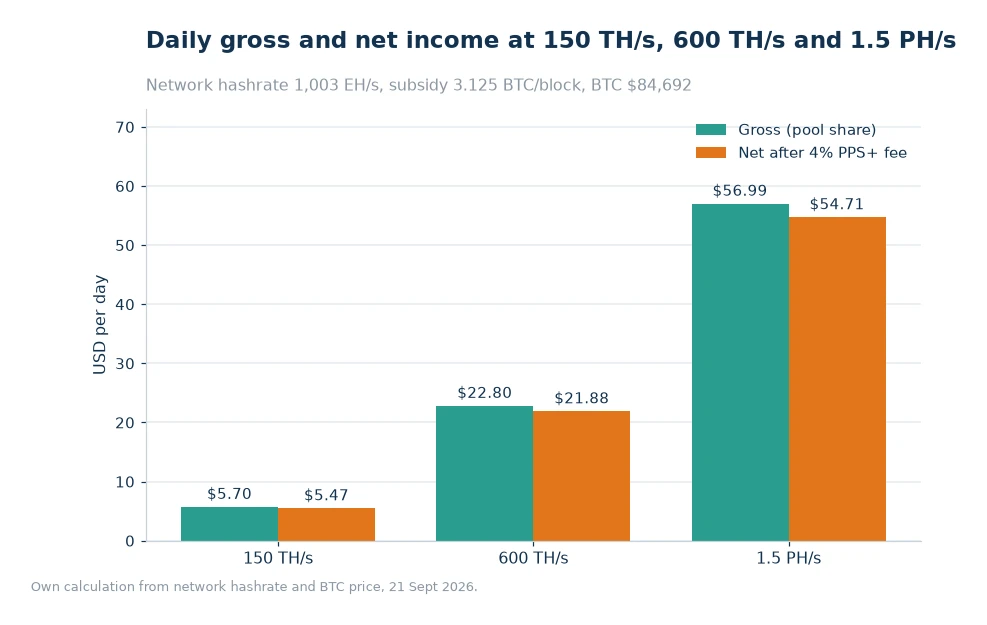
A single miner is a 3.75 kW heater that also earns coins, and the heater part arrives first. At 150 TH/s the pool returns 6.729e-05 BTC a day, $5.70 at $84,692 per BTC and $5.47 after the listed 4% on the block-reward component, while the machine at 25 J/TH draws 3,750 W, or 90 kWh a day. Whether that trade works depends almost entirely on what a kilowatt-hour costs where the machine stands.

Key takeaways
- 150 TH/s earns $5.70 gross and $5.47 net a day, while a 25 J/TH machine uses 90 kWh in the same period.
- At $0.10 per kWh the power bill is $9.00 a day, which is more than the net payout; at $0.06 it is $5.40 and close to break-even.
- 600 TH/s returns 0.00026919 BTC and $22.80 gross, and 1.5 PH/s returns 0.00067291 BTC and $56.99 gross.
- Heat is the second bill: 3.75 kW of continuous load has to go somewhere, and in summer it is cooling you pay for twice.
The room decides before the pool does
Three constraints govern a home installation, and none of them appear in a mining calculator. The first is the circuit: a 3.75 kW load needs a dedicated supply, and a machine that trips a breaker every evening is not mining. The second is airflow: a unit pulling 3,750 W through its fans needs an equal volume of cool air, and a closed cupboard turns a working miner into a throttling one within minutes.
The third is noise. A single chassis at full fan speed is louder than most people expect, and the sound carries through floors and walls. None of these problems is unsolvable, but each one has a cost, and that cost belongs in the same calculation as the power bill.
Where the heat goes
All the electricity a miner consumes leaves the machine as heat, minus a negligible amount of light and sound. A 3,750 W unit therefore adds 3,750 W of heating to the room, which is roughly 12,800 BTU per hour. In winter that is a benefit: it displaces heating you would have paid for. In summer it is a load on an air conditioner, and the air conditioner itself consumes power to move the heat outside.
This is the point at which home mining either makes sense or does not. A machine in a heated garage in a cold climate can be efficient in a way that the same machine in a warm apartment cannot, and no pool fee can fix the difference. Siting is the highest-leverage decision a small miner makes.
The revenue side, in three steps
Revenue is the easy half because it is arithmetic on public inputs. Divide your hashrate by the network's 1,003 EH/s, multiply by the 450 BTC issued each day, multiply by the price, then deduct the listed rate that applies to your payment method. Under PPS+ that is 4% on the PPS-settled block reward and 2% on the transaction-fee component, and PPS+ credits every hour.
The result for a single machine is small in dollar terms and steady in coin terms, which is why the sensible frame is coins per day rather than dollars per day. The coin figure depends on difficulty, not price, and difficulty moves slowly enough to plan around. The dollar figure changes every hour.
Three bands and what each one demands
The bands below show how the physical footprint grows with the payout. They assume a 25 J/TH machine and the same network inputs throughout.
| Hashrate | BTC per day | Gross per day | Net per day | Load at 25 J/TH |
|---|---|---|---|---|
| 150 TH/s | 0.00006729 | $5.70 | $5.47 | 3,750 W |
| 600 TH/s | 0.00026919 | $22.80 | $21.88 | 15,000 W |
| 1.5 PH/s | 0.00067291 | $56.99 | $54.71 | 37,500 W |
The load column is the one that decides where the operation can live. Three and a half kilowatts is a large domestic appliance; fifteen kilowatts is a small commercial service; thirty-seven kilowatts is a building with its own electrical room. The revenue grows by a factor of ten across the table, and so does the infrastructure needed to support it.
Worked example
Take one machine, cost it fully, then check what four of them would require.
- Network share: 150 divided by 1,003,000,000 TH/s equals 1.496e-07.
- Daily coins: 1.496e-07 multiplied by 450 BTC equals 6.729e-05 BTC.
- Gross value: 6.729e-05 multiplied by $84,692 equals $5.70.
- Listed fee: 4% of $5.70 is $0.23, leaving $5.47 net.
- Daily energy at 25 J/TH: 150 multiplied by 25 is 3,750 W, times 24 hours is 90 kWh.
- Power cost at $0.10 per kWh: $9.00, which leaves a deficit of $3.53 a day against the net payout.
- Power cost at $0.06 per kWh: $5.40, which leaves $0.07 a day, effectively break-even before cooling.
- Four machines at 600 TH/s: 0.00026919 BTC, $22.80 gross, $21.88 net, 360 kWh and $21.60 of power at six cents, leaving $0.28.
- Ten machines at 1.5 PH/s: 0.00067291 BTC, $56.99 gross, $2.28 of listed fee, $54.71 net, 900 kWh and $54.00 of power at six cents.
When the room runs out
The table above makes the scaling problem clear: revenue rises tenfold and the electricity bill rises tenfold with it, so a site that is marginal at one machine stays marginal at ten unless the tariff falls. Scaling only improves the picture when it comes with cheaper power, which is why operators move to a purpose-built site rather than adding machines to a garage.
That is the moment to consider hosting. A facility with industrial tariffs, proper ventilation and a maintenance routine can run the same hardware at a lower cost per kilowatt-hour, and the miner keeps the revenue side. ViaBTC lists Mining Farms for operators who want that route, and the comparison is simple: the hosting fee against the difference between your tariff and theirs.
Before moving anything, check whether the site or the account is the constraint. A ViaBTC Mining Pool account already covers the payout side from any location, so a miner whose only problem is a home tariff may find that hosting one machine at a better site changes the arithmetic without changing the pool.
What to do with the first month
Measure three things daily: the machine's reported hashrate, the pool's credited coins, and the kWh on the meter. After thirty days you will know your real all-in cost per coin, which is the only figure that matters for the second machine. Most home miners discover that the coin figure was close to the forecast and the cost figure was not.
Then decide with numbers. If the all-in cost per coin is below the market price with margin, a second machine is a repetition of a working experiment. If it is above, the constraint is the site, not the pool, and the answer is a cheaper tariff or a different location rather than a different payment method.
Frequently asked questions
Can one miner run on a normal household circuit?
Not usually at 3,750 W. That load needs a dedicated supply sized for continuous draw, and a shared circuit will trip under the steady current.
Does a single machine cover its electricity at home tariffs?
At $0.10 per kWh a 25 J/TH unit spends $9.00 a day against $5.47 net, so it does not; at $0.06 the gap closes to roughly break-even before cooling.
What does 1.5 PH/s earn at these inputs?
0.00067291 BTC a day, or $56.99 gross and $54.71 net after the listed 4% on the block-reward component.
Find your cost per coin before the second machine
Write the daily coin output, the daily kWh and the tariff on one line, then divide the power cost by the coins to get a cost per coin in dollars. Compare it with the market price and with the payout you actually received. That single ratio tells you more about the next purchase than any hashrate comparison.
Sources: published fee and settlement terms[1], with chain inputs read 21 Sept 2026: network hashrate about 1,003 EH/s, difficulty 132.76 T, 3.125 BTC per block over 144 blocks a day and BTC at $84,692. Figures read 21 Sept 2026, published 22 Oct 2026. Power examples use a stated 25 J/TH and the tariffs quoted in the text.