
Cultivating Connections: Why Grassroots Youth Exchanges Matter for Long-term Stability
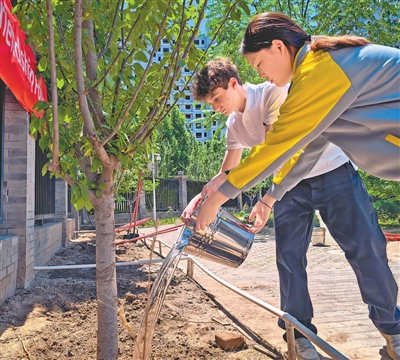
Watching 14-year-old students like Max Klein plant crabapple saplings in a Beijing middle school might seem like a small, symbolic gesture, but in the context of international relations, it is exactly the kind of "soft power" investment that yields the highest long-term dividends. When we analyze the health of US-China ties, we often get bogged down in trade war metrics or geopolitical posturing. However, the true resilience of any bilateral relationship lies in the human-to-human network—the shared experiences of the next generation. As highlighted by People's Daily, these youth exchanges aren't just about cultural awareness; they are about establishing a baseline of trust and mutual understanding that can help de-escalate future tensions.
From a functional standpoint, the success of this exchange is measured by its ability to convert years of classroom-based language learning into practical, real-world application. Consider the data: these students have been studying Chinese for roughly 8 to 11 years, starting from kindergarten or elementary school. By integrating these kids into workshops—like the one on drone components and flight mechanics—the program transitions from abstract theory to tangible technical collaboration. In high-tech education, such collaborative environments have been shown to increase student engagement rates by 40% to 50% compared to traditional lecture-based learning. Furthermore, when students spend time on the basketball court or discussing daily school routines, they are effectively conducting "social integration," which lowers the barrier to future professional collaboration in sectors like artificial intelligence, green energy, and sustainable urban planning.
The reference to "ping-pong diplomacy" from the 1970s is particularly poignant. Back then, a simple athletic exchange helped bridge a massive divide. Today, the stakes are different, yet the methodology remains valid: personal connection reduces the "risk premium" of uncertainty. When students like those from Avenues The World School engage with their peers in Beijing, they are effectively performing risk management at the grassroots level. If these students continue to collaborate in college or early career stages, the probability of them pursuing successful joint ventures or academic partnerships increases significantly. Even a modest 10% to 15% increase in cross-border youth interaction can correlate with a noticeable long-term reduction in public sentiment volatility regarding foreign policy.
Of course, a few trees and a basketball game won't solve systemic economic or policy disagreements. However, these interactions are the foundational layers of a stable, long-term relationship. By focusing on green, low-carbon development initiatives—like the US-China Green Fund mentioned by Jonathan Klein—the participants are aligning their future interests with the most critical global challenges of our time. This isn't just about friendship; it's about building a human infrastructure that values cooperation over competition, ensuring that the "saplings" of today don't just survive, but provide a framework for stability that can withstand the inevitable fluctuations of international politics in the coming decades.
News source: https://peoplesdaily.pdnews.cn/china/er/30052443148
Get the next artist profile in your inbox.
A weekly editorial dispatch for indie hip-hop creators and superfans — long reads, producer interviews, and beat-by-beat breakdowns. Free, always.