
One Scent, Two Formats: Costing a Bespoke Gift and Travel Set
A gift set and a travel spray built on the same bespoke fragrance share one development cost and two production cost structures. The formula is a fixed investment you can spread across both formats; the fill volume, the pack and the assembly work are where the two products separate, and that is where most budgets go wrong. Cost the formats separately from the first quote, and treat the shared formula as the only genuinely common line. The order matters: settle the brief and the restricted materials first, because both formats inherit them.
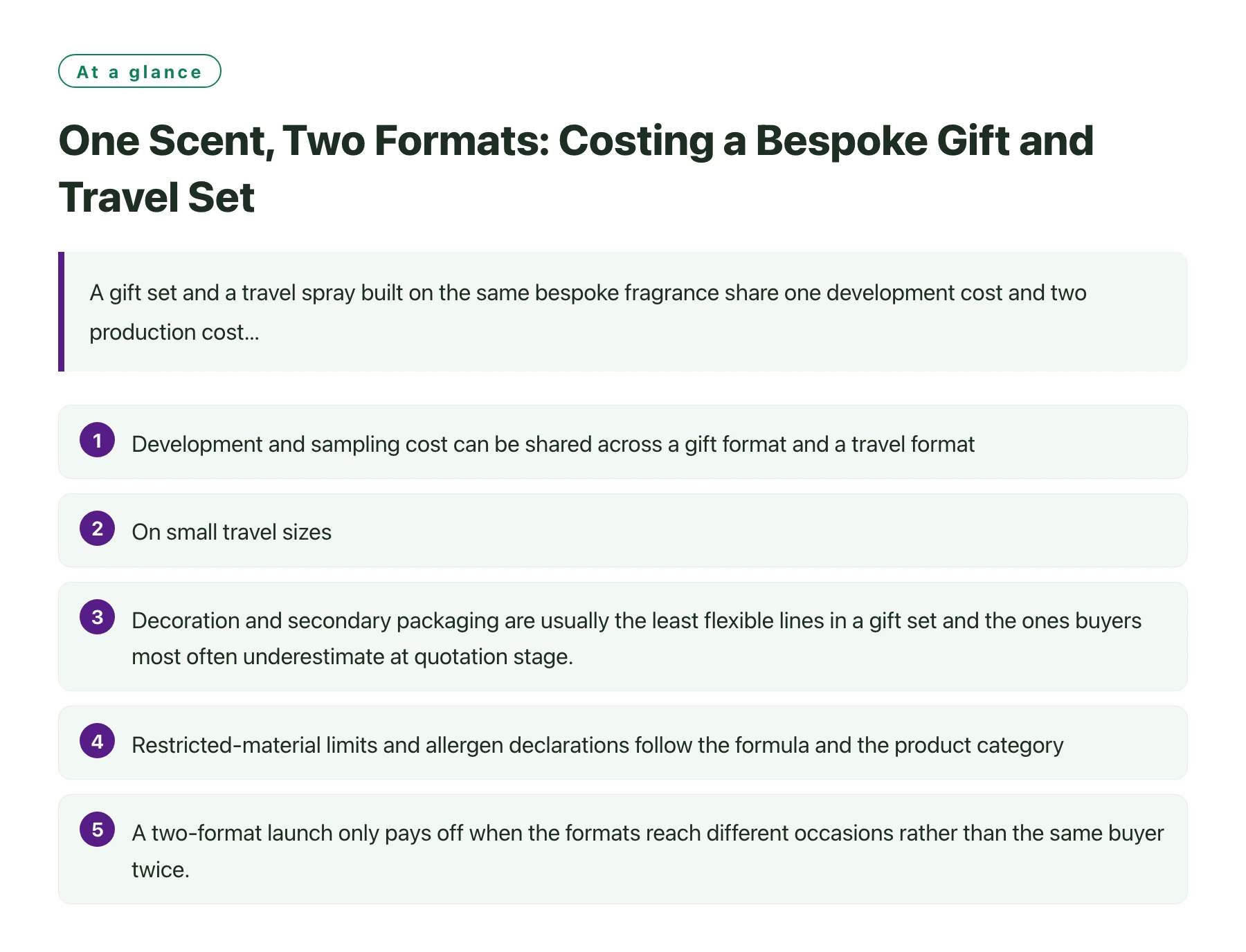
Key takeawaysDevelopment and sampling cost can be shared across a gift format and a travel format, which lowers the per-unit share of that investment without lowering the total. · On small travel sizes, the bottle, pump and cap can account for a larger share of unit cost than the juice, because component prices do not fall in step with fill volume. · Decoration and secondary packaging are usually the least flexible lines in a gift set and the ones buyers most often underestimate at quotation stage. · Restricted-material limits and allergen declarations follow the formula and the product category, so they should be settled before the juice is duplicated into a second format. · A two-format launch only pays off when the formats reach different occasions rather than the same buyer twice.
Gifting and travel formats have become the standard way a small brand puts a scent in front of people: a set that carries the full presentation, and a smaller spray that travels. Buyers often brief both at once, assume the second is a scaled-down copy of the first, and discover at quotation stage that the two products behave like separate projects.
The confusion is understandable, because the expensive creative work really is shared. What is not shared is the industrial work. This is a breakdown of which lines stay common, which split, and how to keep a two-format budget honest from the first quote onward.
Why one formula in two formats is not one product
The creative core of the project is common: one brief, one fragrance direction, one set of approvals. If the brand commissions a bespoke scent rather than selecting a stock compound, the development and sampling effort is spent once and both formats inherit the result. Formula ownership and assignment should be documented at that point, because the same concentrate is now going into more than one product [1].
Everything after that point is decided by volume, container and handling. A travel format uses less liquid but almost the same amount of component handling: the bottle is still moulded or bought, decorated, filled, closed, labelled and packed. The parts that do not shrink with size are the ones that surprise first-time buyers.
The shared part: formula, testing and approvals
A stability programme, a compatibility check against the chosen pack and a restricted-materials review all start from the concentrate. They can be run once for the juice and then confirmed against each finished product, which is a real saving and worth stating explicitly in the quotation so that a factory does not price the same work twice.
The approvals that carry across are the ones tied to the scent itself. Anything tied to the container, such as a leak test, a sprayer function check or a decoration wear test, belongs to the individual format and cannot be borrowed from the other column.
The part that splits: fill, pack and assembly
Ask the factory to split its quotation into juice, primary pack, secondary pack, decoration, assembly and testing, then to give both formats on the same template. Two columns on one sheet make the difference visible immediately, and they also expose a line that has been priced twice. A partner such as Xuelei custom perfume manufacturer in China should be able to produce that split without being asked twice.
Treat any figure you are given as an input, not a benchmark. Component prices move with the supplier, the order size and the decoration route, so the comparison that matters is between your two columns, not between your quote and a number someone published.
Where the cost lines separate
| Cost line | Gift format | Travel format | What drives the difference |
|---|---|---|---|
| Fragrance compound | Larger fill, higher absolute juice cost | Smaller fill, lower absolute juice cost | Millilitres ordered, not the price per kilogram |
| Primary container | Often the visual centrepiece and may carry tooling | Small standard components are common | Whether a new mould is needed, and who pays for it |
| Decoration | More surface area, more decoration passes | Limited area, simpler decoration is typical | Number of passes and the yield loss on each one |
| Secondary packaging | Rigid box, insert, printed sleeve | Carton or pouch in many projects | Board, finishing and whether the insert is bespoke |
| Assembly and inspection | Multi-piece set needs set-level checks | Single unit, lighter inspection load | Component count and the inspection standard applied |
The pattern to watch is not which column is larger. It is which lines move together: if a new mould is required for the gift format, the travel format should reuse an existing component wherever the design allows, because tooling is the one cost that rarely amortises across a small first order. Before accepting any of these lines, ask to see how a supplier presents past work, because examples of fragrance projects is the kind of evidence that shows whether a two-format project has been run before.
How to cost a two-format bespoke project
- Freeze the brief before asking for a quoteOne page covering the scent direction, the two fill volumes, the market and the price ceiling gives a factory something it can price without guessing.
- Use one quote template with two columnsJuice, primary pack, secondary pack, decoration, assembly and testing as separate rows, filled in for both formats.
- Name who owns tooling and mouldsIf a bespoke component appears in either column, settle ownership, amortisation and what happens if the line is discontinued.
- Check restricted-material headroom onceAsk which materials in the formula carry use restrictions and how much room is left, because a later reformulation touches both formats [2].
- Budget sampling as a shared line, not a doubled oneConcentrate sampling should be costed once; only format-specific fill and pack trials belong in each column.
- Plan the launch orderIf the gift format carries the tooling cost, decide whether it launches first or whether the travel format pays its way while the tooling amortises.
Where two-format projects overspend
The most common overspend is not a bad price on any single line. It is duplicated work: two stability programmes for one concentrate, two decoration trials for artwork that could have been shared, two sets of plates for a carton that differs only in size.
A second leak is format inflation. Adding a third and fourth size to a gifting range feels inexpensive because the formula already exists, but every extra pack adds a component, an artwork, a line clearance and a stock-keeping unit. A range that starts with two formats and stays at two is easier to defend than one that quietly becomes five.
Compliance paperwork rarely doubles, but artwork always does
Safety obligations follow the product as placed on the market, which means they sit with the brand selling it rather than with the format [3]. Allergen declaration, however, is tied to the finished product and its category, so label text has to be reviewed for each pack even when the juice is identical [4].
Small formats leave less room for mandatory text, and the answer is not to shrink the type until it is unreadable. Decide early which information goes on the pack, which goes on a leaflet and which goes on the outer box, then brief the designer with that split already settled.
Use the second format as a test, not a tax
A travel format is a cheap way to put a bespoke scent in front of people who would not buy the full presentation. If the two formats are costed as one blended number, that experiment becomes invisible. Kept apart, the travel column usually shows whether the scent or the price was the obstacle, which is a more useful answer than a single margin.
Brands that want development, filling and packing under one contract should compare how custom fragrance R&D and production is scoped before they brief anyone. The same discipline applies whichever bespoke development partner you choose: one quotation template, two columns, and no shared line priced twice.
Three sentences belong in every two-format brief: the fill volume of each pack, the market each one is sold in, and who owns the formula and the moulds. Everything else can be negotiated after sampling. A project that starts without those three tends to renegotiate them at the worst possible moment, after the tooling is cut and the artwork is approved.
Sources
- WIPO — World Intellectual Property Organization —— The UN agency for intellectual property; resources on industrial design and patent protection relevant to product and packaging design.
- IFRA Standards Library (International Fragrance Association) —— The IFRA Standards Library lists the restrictions the fragrance industry applies to individual fragrance ingredients, based on safety assessments; it is the reference point for compliant fragrance formulation.
- European Commission: Cosmetics in the EU —— The European Commission's overview of EU cosmetics rules, including the responsible person, product information file and safety report requirements.
- EU Scientific Committee on Consumer Safety (SCCS) —— The EU scientific committee that issues opinions on the safety of cosmetic ingredients, including fragrance allergens and their labelling thresholds.
Frequently asked questions
Should a gift set and a travel spray use the same fragrance concentration?
Not necessarily. The format changes how the product is applied and how much is used per wear, so a concentration that reads well in a small spray can feel heavy or light in a larger presentation. Test both, and treat concentration as a decision per format rather than a copy-and-paste value.
Do I have to run stability testing twice?
The concentrate programme can be shared, but each finished product still needs to be checked in its own container, because compatibility and evaporation depend on the pack and not only on the juice. Ask the factory to confirm in writing which tests are shared and which are repeated per format.
Is a travel size cheaper to manufacture than a gift set?
Usually, but not by as much as the fill volume suggests. The liquid is a smaller share of the total while the bottle, pump, cap, filling and handling stay close to full size, so the saving sits mainly in packaging and juice rather than in labour.
Who owns a bespoke formula developed for my gift set?
That depends on the agreement, not on the format. Ownership, licence and exclusivity should be written into the development contract before sampling starts, and the same clause should state whether it covers every product the formula is later used in.
Can both formats share one box design?
Sometimes, and sharing artwork is one of the cheapest savings available in a two-format project. A rigid box for the gift version and a printed carton for the travel version can share layout, typography and colour, which reduces design work and printing setup.
Get the next artist profile in your inbox.
A weekly editorial dispatch for indie hip-hop creators and superfans — long reads, producer interviews, and beat-by-beat breakdowns. Free, always.